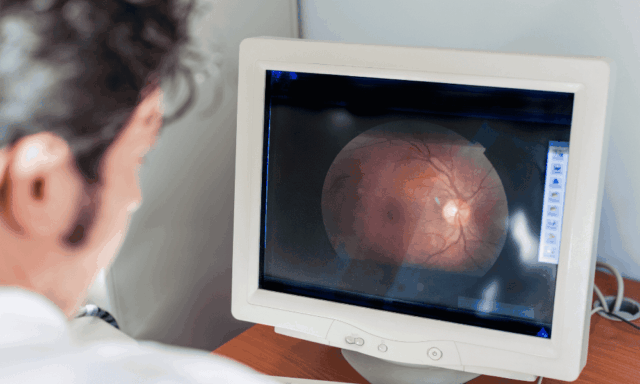
You may not yet be routinely thinking of your retinal exams as part of systemic health screening, but that’s exactly where the field of oculomics is heading.
The idea that the eye offers clues to overall health isn’t new, but oculomics makes it measurable, using high-resolution ocular imaging and AI to detect biomarkers of cardiovascular, renal, metabolic, and even neurologic disease long before overt signs appear.
A June 2025 article in The Ophthalmologist noted that since the term “oculomics” was coined in 2020, more than 400 papers have been published. That momentum suggests optometry is poised to play a much larger role in systemic health.
Here are a few key developments from this year that are especially relevant for ODs to keep tabs on.
1. AI-enhanced retinal imaging as biomarkers for systemic disease
A major review published in early 2025 showed that AI-driven analysis of retinal images (color fundus, OCT, OCT-A) is now reliably linked to predicting a broad range of systemic diseases: cardiovascular, renal, metabolic and neurologic.
One real-world study applied radiomic features from multimodal retinal images to a cohort of type 1 diabetics and achieved near-perfect accuracy in predicting cardiovascular risk, especially when OCT and OCT-A data were included.
Other research has shown that AI can also estimate systemic risk factors such as smoking status, age, and blood pressure directly from fundus images, often with remarkable accuracy, which strengthens the case for oculomics’ potential to detect disease risk even before clinical signs appear.
Caveat: Image quality, algorithm bias, and generalizability remain concerns. As you know, AI is only as good as the data it is trained on. To prepare for future integration, focus on capturing excellent image quality and consistent documentation (for example, vessel calibre, tortuosity, and capillary density in OCT-A). These are the metrics researchers are currently feeding into AI models.
Related read: A New, Great Indicator (Review of Optometry)
2. Multi-modal imaging & foundation models
Recent research is moving beyond single-image analysis toward foundation models that learn from multiple imaging types — fundus, OCT, and OCT-A — at once. These large-scale AI systems are designed to detect subtle patterns linked to systemic conditions like hypertension and diabetes. A mid-2025 study introducing FusionFM showed that combining data from multiple test types improved prediction accuracy and held up across different patient populations.
As imaging technology becomes more integrated, the value of consistent, high-quality scans only continues to grow.
3. Opt-in data sharing
Device makers are laying the groundwork for the next step in clinical use: voluntary data-sharing networks. Platform vendors like Topcon (Harmony) and ZEISS (Research Data Platform) are developing AI-enabled data-management systems that enable clinics and researchers to securely aggregate imaging data for AI development.
Participation is generally opt-in and governed by explicit consent and de-identification protocols. In other words, your imaging data doesn’t leave your practice or get used for model training unless you choose to enroll. But be sure you understand each vendor’s policies in advance.
4. Retinal microvasculature and neurodegenerative disease
New findings reinforce that alterations in retinal nerve fiber layer (RNFL) thickness, ganglion cell layer integrity, and capillary density (via OCT-A) correlate with risk for neurodegenerative conditions such as Alzheimer’s and Parkinson’s disease.
The 2025 meta-analysis “The Eye as a Window to Systemic Health” reaffirmed that the retina gives noninvasive access to neural tissue and vasculature, making it a candidate for early brain disease screening.
Thoughts for the forward-thinking OD
Even though research is robust, cost-effectiveness, reimbursement, and regulations are still evolving. But there are ways to prepare your practice in the meantime.
- As mentioned up top, optimize your imaging protocols to produce high-quality, repeatable scans and link the data to your patient records in a way that allows tracking. This will improve your data quality and make it easier to adopt new technologies as they become available.
- Record patient demographics and deviations from normative OCT/OCT-A data (even in asymptomatic patients) so you’ll be able to identify subtle changes over time.
- Build relationships with cardiology, nephrology, and neurology providers so that when you identify concerns, you have a referral network.
- Be on the lookout for developments. As AI/oculomics advances, new imaging tools and software will likely make systemic risk assessment easier to incorporate into your practice.