A practical Q&A for ODs exploring new services.
Aesthetics has been getting more and more attention in optometry, especially as ODs fold IPL, RF, and lid-health treatments into their dry eye services. And noninvasive aesthetic care is part of a much larger U.S. market valued at about $20.8 billion. With that kind of growth, it’s easy to see why some practices are thinking about adding such services as a cash-pay addition.
But where to start? This Q&A is designed to walk you through the foundational questions to ask before adding ocular aesthetic or medical-spa services. It’s helpful if you’re already running a dry eye clinic or if you’re starting with almost no familiarity with the aesthetics space.
What falls under ocular aesthetic services, and where would I even begin?
A common entry point is IPL and RF, which are already well-established in managing MGD and ocular rosacea but also provide cosmetic benefits like skin tightening or reduced redness.
Another typical first step is to enhance your existing lid-hygiene protocols with products or in-office debridement tools. It’s a cautious approach that can help you understand workflow and pricing strategies without major investment.
More advanced services like microneedling, peels, or injectables require significantly more training and regulatory considerations, so it’s reasonable to save those decisions for later.
In a helpful piece recently published by Optometric Management, Janelle Davidson, OD, proposes you evaluate offering aesthetic optometry by breaking it down into these 3 buckets:
1. Fundamental eye spa. This option required me to invest between $100,000 to $150,000 for equipment and overhead. Services under this bucket include skin health product recommendations, nutritional supplements for aging support, therapeutic cosmetic products, and treatments, such as IPL and radiofrequency therapy. Staffing for this bucket typically requires 1 additional team member to manage spa inventory, and treatments that can be delegated.
2. Intermediate eye spa. This level enables optometrists to provide all the services available in the fundamental eye spa, while fostering collaborations with aestheticians, lash, and makeup artists. Offerings here include lash extensions, hydrofacials, dermaplaning, professional makeup sessions, and chemical peels.
3. Advanced eye spa. These services may include neurotoxin injections (such as botulinum toxin), microneedling with radiofrequency, and CO2 laser-resurfacing around the eyes. Although this level demands greater investment in staff and equipment, it offers substantial revenue potential. (Source: Offering Ocular Aesthetics)
How do I know whether my practice identity can support aesthetics?
Think about how new services will fit into the way patients already see you. If your practice is known for dry eye, advanced tech, or specialty care, aesthetics could be seen as a natural extension. On the other hand, if you’re better known for routine exams or family care, you may want to ease into things more slowly (or even create a separate brand identity).
Ultimately, what matters is clarity. Your patients need to understand where medical care ends and elective services begin.
Will my current patient base support this?
You can get a quick sense by reviewing your patient mix. A large dry-eye population, high contact-lens wearers, frequent MGD cases, or many adults over age 40 often indicate strong potential for interest. Dr. Davidson found “communities comprised of a balanced mix of older millennials, Generation X, and baby boomers” tend to be more interested. Ask questions directly (or on intake forms) to help you determine interest.
If most of your patients are young, budget-conscious or highly insurance-driven, demand may be lower. It doesn’t mean ocular aesthetics is off the table, but it might require new outreach or targeted marketing rather than relying on internal referrals.
What kind of training do I need?
Even if you choose a relatively intuitive device, you and your team will need focused education. COPE-approved ocular aesthetics programs exist specifically for ODs and include hands-on labs for IPL, RF, microneedling, and related techniques. Look to conference courses for vetted options.
Training is important for safety and for confidence in patient selection. Knowing who is an ideal candidate — or who isn’t — protects you and paves the way for successful outcomes.
Are there state-specific rules I need to understand?
Definitely. Regulations vary widely. Some states allow ODs to perform IPL, RF or other energy-based treatments directly. But others require physician collaboration or limit what support staff can do, even under supervision.
Before buying any device, you should confirm:
• who can legally perform each procedure
• what documentation or consent you need
• whether your malpractice coverage includes aesthetic services
• whether the procedure counts as medical or cosmetic for state purposes
This step alone prevents costly missteps down the line.
What should I be looking for when evaluating devices?
This is where many ODs feel overwhelmed. A practical approach can help. Here’s three criteria:
1. Clinical evidence
Look to devices with published data in ocular surface disease, MGD, or periorbital treatments. Not all IPL or RF systems are designed for eyelids.
2. The numbers
Beyond the list price of the device, you have to consider consumables, maintenance fees, and how many treatments you realistically expect per month.
3. Workflow fit
Some devices require more space, longer appointments, or extended cooldown times that will impact scheduling. Others are designed for quicker use. It’s important to understand the logistics.
Keep in mind that you can get started without a large suite of aesthetic equipment; one well-chosen device can carry a new program through its first year.
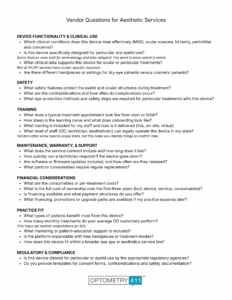
For those ready to speak to a vendor, we’ve prepared a handy list of questions/topics you’ll want answered before making any final decisions.
What’s a reasonable financial expectation for year one?
Industry benchmarks suggest that a basic eye spa setup, as detailed by Dr. Davidson in the quote box up top, typically requires an initial investment in the low six-figure range. But the revenue potential can be strong, particularly if your patient base already fits the bill.
A simple ROI model helps. Estimate the number of dry-eye or MGD patients who may convert to IPL or RF. Then layer in elective cosmetic interest. Compare that potential volume against monthly payments, disposables, and staff time.
Recommended read: How to Build Aesthetic Optometry Services Comprising 30% of Practice Revenues
How will these services affect my daily operations?
Expect to make adjustments to scheduling and staff roles. As for patient flow, some practices create dedicated blocks for aesthetics.
You’ll also likely need to add short educational consults and incorporate before-and-after photos in discussions. And your team will need to learn how to discuss elective service pricing comfortably — a distinct skill set!
What should I do first if I’m seriously considering this?
Step 1: Audit your patient base. Look at your dry-eye numbers, lid-disease cases, repeat visits, and demographics.
Step 2: Attend a hands-on training. Even one workshop can give you insight on whether aesthetics feels like a natural fit.
Step 3: Talk to vendors, but only after you know your goals. Use our list of questions to make informed purchasing decisions.